
A Medicare coverage review meeting is a formal consultation designed to evaluate your current medications, identify coverage gaps, and confirm that your plan still fits your health needs. The formal term for the medication component is a Comprehensive Medication Review, or CMR. The CMR is a federally mandated service under the Medicare Modernization Act, created to reduce risks from polypharmacy and protect seniors from preventable harm. Knowing how to prepare for a Medicare coverage review meeting gives you the best chance of walking out with a plan that costs less and covers more.
What documents do you need for a Medicare coverage review meeting?
The single most important thing you can bring is a complete, accurate medication list. That means every prescription drug, every over-the-counter medication, every vitamin, and every supplement. Accurate medication labels showing dosage, frequency, and prescriber names improve review outcomes more than any other single document. Bring the original bottles or clear photos of the labels if carrying them all is not practical.
Beyond medications, your medical records round out the picture. Recent lab results and health changes are critical for identifying medication-related problems that might otherwise go unnoticed. Include immunization records, notes from recent hospital visits, and any new diagnoses. If a close family member has a history of heart disease, diabetes, or cancer, note that too, since it can affect prescribing decisions.
Your Medicare card and current plan documents belong in the folder as well. The reviewer needs to see exactly what coverage you have today before recommending any changes.
Here is a practical Medicare coverage checklist to organize before your appointment:
- All prescription medications: drug name, dose, frequency, and prescribing doctor
- Over-the-counter drugs and supplements: include vitamins, herbal remedies, and sleep aids
- Original medication bottles or label photos: for accuracy on dosage and refill dates
- Recent lab results: blood work, imaging reports, or specialist notes from the past 12 months
- Immunization records: flu shot, shingles vaccine, COVID-19 booster dates
- Notes on recent health changes: new symptoms, hospitalizations, or diagnoses
- Medicare card and current plan summary: Part A, Part B, Part D, or Medicare Advantage documents
- Family health history: relevant conditions that may influence your medication plan
One preparation step most seniors skip is building a medication timeline. A medication timeline documents start dates, dosage changes, and discontinuations, giving the pharmacist essential context to spot adverse reactions or interactions. If you started a new blood pressure medication in march and noticed dizziness in april, that sequence matters. Write it down.
Pro Tip: Take photos of every medication label with your phone before the meeting. Store them in a single album labeled “Medicare Review” so you can pull them up instantly during the consultation.
How do you identify and organize questions for your Medicare meeting?
Preparation is not just about paperwork. The questions you bring define the quality of the conversation. Beneficiaries who bring written lists of specific health concerns report a 78% higher satisfaction rate with consultation outcomes. That number reflects a real difference in how much useful information gets exchanged when you arrive ready to talk.
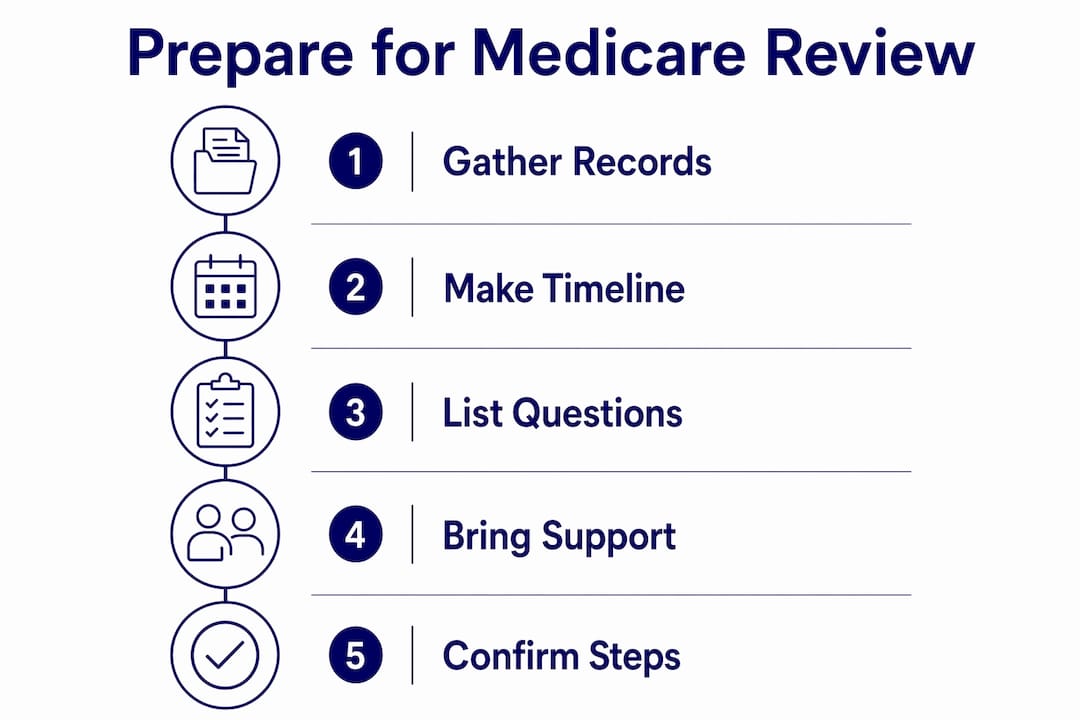
Start by writing down anything that has bothered you since your last review. Side effects that disrupt sleep, medications you sometimes skip because of cost, doses that feel too high or too low. These are not complaints. They are clinical data points your pharmacist or agent needs.
Strong questions to bring to your Medicare coverage meeting include:
- Is every medication I take still necessary? Medications prescribed years ago may no longer be appropriate for your current condition.
- Are there lower-cost alternatives on my plan’s formulary? A formulary is the list of drugs your plan covers. Generic substitutions can cut costs significantly.
- Could any of my medications interact with each other? Polypharmacy, taking five or more drugs simultaneously, raises interaction risk sharply.
- Am I taking the right doses? Weight changes, kidney function, and age all affect how your body processes medication.
- What should I do if I miss a dose or experience a side effect? Clear instructions prevent dangerous improvisation.
Bringing 3–5 clear questions to the review reduces follow-up appointments by 40%. That efficiency matters, especially if you manage multiple conditions. Prioritize your questions by urgency. Put the medication that worries you most at the top of the list.
Pro Tip: Ask a trusted family member or friend to attend the meeting with you. A second set of ears catches details you might miss, and having someone take notes frees you to focus on the conversation.
What happens during a Medicare coverage review meeting?
The meeting typically runs 45–60 minutes and follows a structured format. The pharmacist or licensed insurance agent reviews your complete medication and health profile, flags potential problems, and discusses your coverage options. Telehealth CMR appointments are now widely available, which is a genuine benefit for seniors in Southwest Florida who face long drives or mobility challenges.

Whether the meeting is in person or by phone, your environment matters. Choose a quiet room, have your medication list and documents within reach, and minimize distractions. If you are using a phone or video call, test the connection beforehand.
Common outcomes from a well-run CMR include:
- A personal medication list: a clean, updated record of every drug you take, formatted for easy sharing with other providers
- A medication action plan: specific steps you and your care team agree to take, such as discontinuing a drug or scheduling a follow-up lab test
- A consultation letter: sent to your primary care physician summarizing the review findings and recommendations
“Patients who actively prepare for their Medicare review reduce hospitalization risks and improve medication safety.” — OnlinePharmacyMD
Before the meeting ends, confirm every next step out loud. Ask who is responsible for each action item. If a medication change is recommended, ask when it takes effect and what to watch for. Do not leave with unanswered questions.
How do you compare Medicare plan options after your coverage review?
The review often surfaces a gap between what your current plan covers and what you actually need. That gap is your signal to compare options. Switching Medicare plans after a review can be advantageous when new coverage needs or cost concerns arise, and understanding plan types is the foundation of that decision.
The four main plan categories are Original Medicare (Parts A and B), Medicare Part D for prescription drugs, Medicare Advantage (Part C), and Medicare Supplement plans, also called Medigap. Each serves a different purpose, and the right combination depends on your health profile and budget.
| Plan type | What it covers | Best for |
|---|---|---|
| Original Medicare (Parts A & B) | Hospital and medical services | Seniors who want broad provider access |
| Medicare Part D | Prescription drugs | Anyone on Original Medicare needing drug coverage |
| Medicare Advantage (Part C) | Bundles A, B, and usually D | Seniors who prefer an all-in-one plan |
| Medicare Supplement Plan G | Covers most Part A and B gaps | Seniors who want predictable out-of-pocket costs |
| Medicare Supplement Plan N | Covers most gaps with small copays | Cost-conscious seniors with fewer specialist visits |
Medicare Star Ratings, published annually by the Centers for Medicare and Medicaid Services, score plans on quality and performance from 1 to 5 stars. A plan rated 4 or 5 stars consistently delivers better care coordination and member satisfaction. Use the Medicare Plan Finder tool at Medicare.gov to compare Star Ratings, premiums, and formularies side by side.
Enrollment periods matter. The Annual Enrollment Period runs from october 15 through december 7 each year. Outside that window, switching plans requires a Special Enrollment Period triggered by a qualifying life event. Knowing your window prevents costly mistakes.
Pro Tip: Check whether your current medications appear on a new plan’s formulary before switching. A lower premium means nothing if your most expensive drug moves to a higher tier.
Key takeaways
Preparing thoroughly for your Medicare coverage review meeting directly reduces hospitalization risk, lowers medication costs, and produces a plan that fits your actual health needs.
| Point | Details |
|---|---|
| Gather complete medication records | Bring original bottles or label photos with dosage, frequency, and prescriber names. |
| Build a medication timeline | Document start dates and dosage changes to help identify adverse reactions. |
| Prepare 3–5 written questions | Specific questions raise satisfaction rates and reduce unnecessary follow-up visits. |
| Know your plan types | Compare Original Medicare, Part D, Medicare Advantage, and Medigap before switching. |
| Confirm next steps before leaving | Agree on action items out loud so nothing falls through the cracks after the meeting. |
What I have learned from watching seniors walk into these meetings unprepared
After years of working with Medicare beneficiaries across Southwest Florida, the pattern is clear. Seniors who treat the CMR as a routine formality leave the same way they arrived. Seniors who prepare walk out with a concrete plan, sometimes saving hundreds of dollars a year on medications alone.
The CMR is not just a formality. It is a federally required safeguard against polypharmacy-related hospitalization, and most people do not realize it is completely free under Medicare Part D. That combination of zero cost and real clinical value makes skipping it one of the most expensive mistakes a senior can make.
The telehealth option has changed things for the better. Seniors in Estero, Cape Coral, and Naples who once skipped reviews because of transportation now have no barrier. A phone call from your kitchen table counts as a full CMR. Use it.
My honest advice: do not wait for your plan to contact you. Request the review proactively, show up with your medication list and your questions, and treat the pharmacist or agent as a partner rather than a gatekeeper. The seniors I see who do this consistently end up with better coverage, fewer surprises at the pharmacy counter, and a clearer picture of what their plan actually does for them.
— Alston
Xactinsure is here when you are ready to review your Medicare options
Preparing for your Medicare coverage review meeting is the first step. Knowing which plan to choose afterward is the second.

Xactinsure works with seniors across Fort Myers, Cape Coral, Naples, and neighboring Southwest Florida communities to compare Medicare plans from multiple carriers. The team offers Medicare plan guidance covering Medicare Supplement Plan G, Plan N, Medicare Advantage, and Part D options, with no obligation to enroll. Free educational seminars and one-on-one consultations are available for seniors who want to understand their options before making a decision. Book a consultation to speak with a licensed agent who knows the Southwest Florida market and can walk you through your choices clearly.
FAQ
What is a Comprehensive Medication Review under Medicare?
A Comprehensive Medication Review is a free, federally mandated consultation under Medicare Part D that evaluates all your medications for safety, effectiveness, and cost. It is required to be offered at least once per year to eligible beneficiaries.
How do I prepare for a Medicare coverage meeting quickly?
Gather your medication bottles or label photos, list your current health concerns, and write down 3–5 specific questions before the appointment. That preparation alone covers the most critical ground.
Is the Medicare annual medication review really free?
Yes. The CMR is free under Medicare Part D and must be offered at least annually to eligible beneficiaries at no cost.
Can I do my Medicare coverage review by phone or video?
Medicare allows telehealth CMR appointments, making the review accessible for seniors with mobility or travel limitations without any reduction in the quality of the consultation.
When is the best time to switch Medicare plans after a review?
The Annual Enrollment Period, from october 15 through december 7, is the standard window for switching plans. A qualifying life event can open a Special Enrollment Period outside that window.
Recommended
- Insurance Articles & Guides - XactInsure Blog
- Medicare Insurance Plans & Guidance - XactInsure
- Free Insurance Seminars & Educational Events
- Medicare Changes 2025 - Drug Prices & Coverage Updates
Article generated by BabyLoveGrowth
Get a Free Professional Insurance Review
Our licensed Southwest Florida specialists serve Lee, Collier, and Charlotte counties with local, family-first protection advice.
Request Free Consultation →